
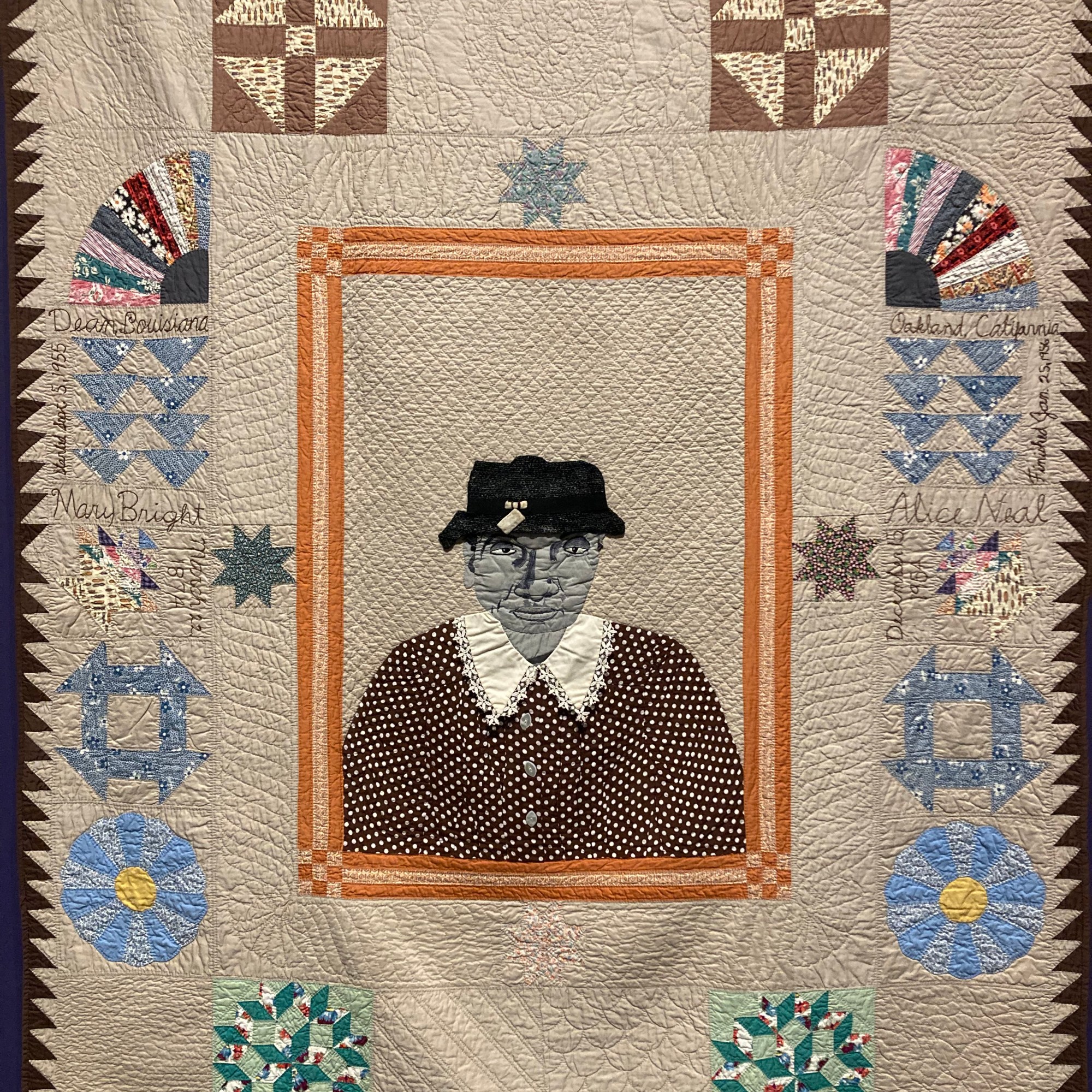


The Routed West: Twentieth Century African American Quilts in California exhibit at Berkeley Art Museum is breathtaking. I was blown away by the skill and artistry displayed in each quilt, the care of the curation and storytelling, and the palpable spirit present inside the galleries. While every quilt held deep meaning, a few stood out to me because of how they embodied creative archival practice.
The quilt highlighted above, with the portrait of the woman in the center was started by Alice Neal a few days after her mother, Mary Bright–also a quilter–passed away. She painted the image from a photograph of her mother, and used cloth from the dress her mother was wearing in the photograph to recreate the dress in the quilt. When she finished it a year later, she hoped to hang the quilt in a museum that she had planned to build on her family’s land in Louisiana. But when the land was bought by a television station (the text panel on the exhibit wall didn’t talk about the circumstances of the sale), she it to the prominent Bay Area quilt collector Eli Leon, because she knew he would be able to best preserve and share the quilt’s story. The fact that Ms. Neal memorialized her mother in this way, using the art form that her mother taught her; the fact that she wanted to tell her mother’s story; the fact that she was planning to open a museum; and the fact that sought out the one person who she thought could best ensure that her mother’s story gets told are all stunning examples of us knowing the value of our lives and stories. Those acts of remembrance and narrative agency are so powerful.
Anita Carse’s beautiful quilt collage depicts her grandmother’s journey west from Africa (during enslavement) to Missouri to Montana, and the freedom that she created for herself and her descendants.
Stacy Carter conducted oral histories with elderly residents of Bayview Hunter’s Point in San Francisco, and shared them with William Rhodes, who depicted them on fabric in a mural about the Hunter’s Point Naval Shipyard.
The literal weaving of Black stories into an art form that is so deeply part of Black culture (in both the act of the making of the quilts and the quilts themselves) is so beautifully Black! I was deeply moved.
 Rebecca Renard-Wilson
Leave a comment