
Over the summer, as I got a chance to do some research for my digital map of Black liberatory arts spaces in Los Angeles, I made a few visits to the Brockman Gallery Collection at LA Public Library’s archives.
I wasn’t necessarily interested in the art work that graced the walls of the Brockman Gallery over the 20+ years it operated in Leimert Park (though, the roster of artists and their work is literally the “who’s who” of not only Black American art, but so many other artists of color nationally and internationally). I wanted to learn more about Brockman Gallery Productions, the non-profit wing of the enterprise. Brockman Gallery Productions, or BGP, was birthed in 1974 as an outgrowth of the for-profit gallery space. Over the 26 years of BGP’s existence, the Davis brothers and their collaborators created a web of relationships, events, programs, workshops, and job opportunities that cemented Leimert Park as a hub of Black cultural identity and production.
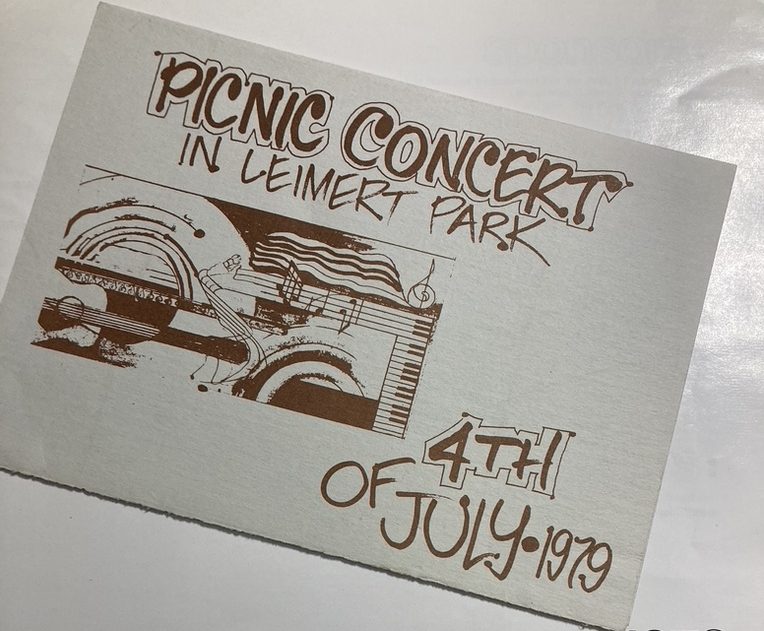
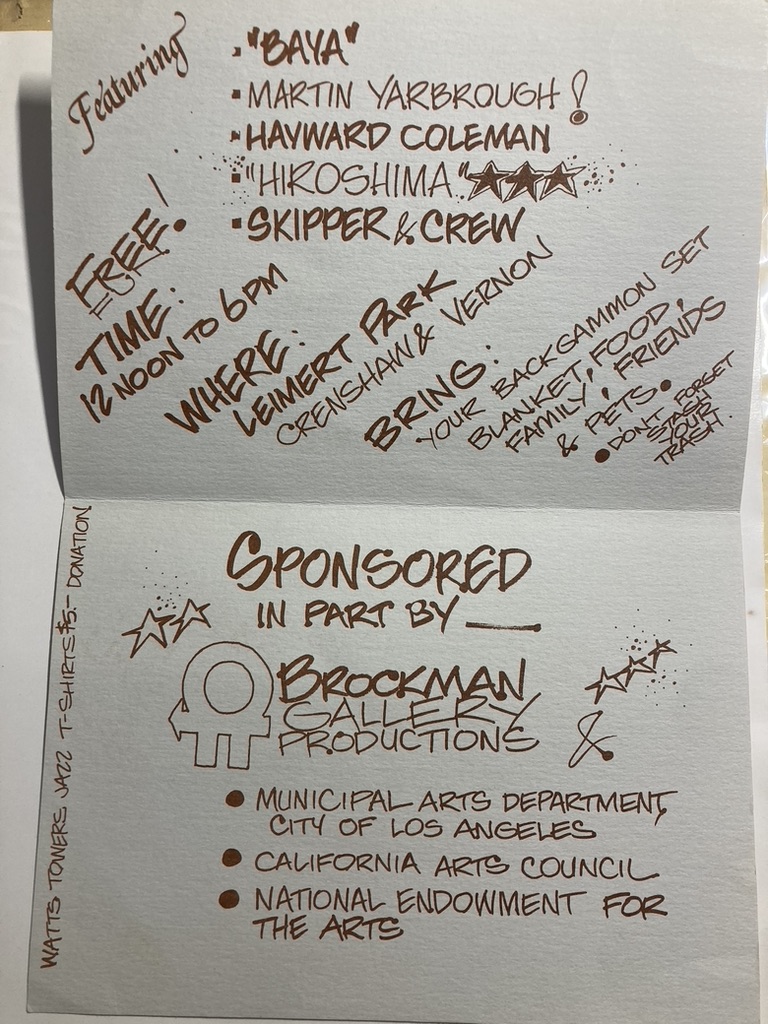
My interest in archival work is driven by a deep and urgent desire to find “blueprints of liberation”—evidence of ways that our ancestors built spaces that allowed for imagination, flourishing, and joy, even as we have existed within the belly of the beast. I am seeking clues of “how we be together” and “what we do together” by combing through records to discern things like an organization’s relational and operational values, the texture and tone of the labor, how conflict was tended to, how we have done business in ways that have enabled resources to flow deeper into communities rather than hoarding wealth at the top… In this way, we can build on and continue the legacy of what worked, shrinking the distance between now and a liberated future.
Given the impact that the Brockman Gallery and Brockman Gallery Productions had on not just Leimert Park, but on the Black arts and cultural movement in this country, I figured I’d be able to find some of those blueprints of liberation in their archive.
Before I get into some of the records I encountered in the collection, I want to share a bit about what I felt from them. I had viewed digitized versions of a few of the collection’s documents on Tessa, and I’d even held replicas of several items that LAPL archivists had selected to exhibit at Lore Bookstore in Leimert Park, which now occupies the actual building that once was home to the Brockman Gallery (Lore’s staff, by the way, do a phenomenal job of connecting their programming to the spirit of what was once there). However, these visits to the Central Library’s Special Collections room was the first time that I’d been able to hold in my hands the actual documents that passed through the hands of Alonzo and Dale Davis, and the artists, educators, administrators, and business owners in their vast constellation.
A page of Alonzo Davis’ planner from May 1980. From the LA Public Library’s Brockman Gallery Collection
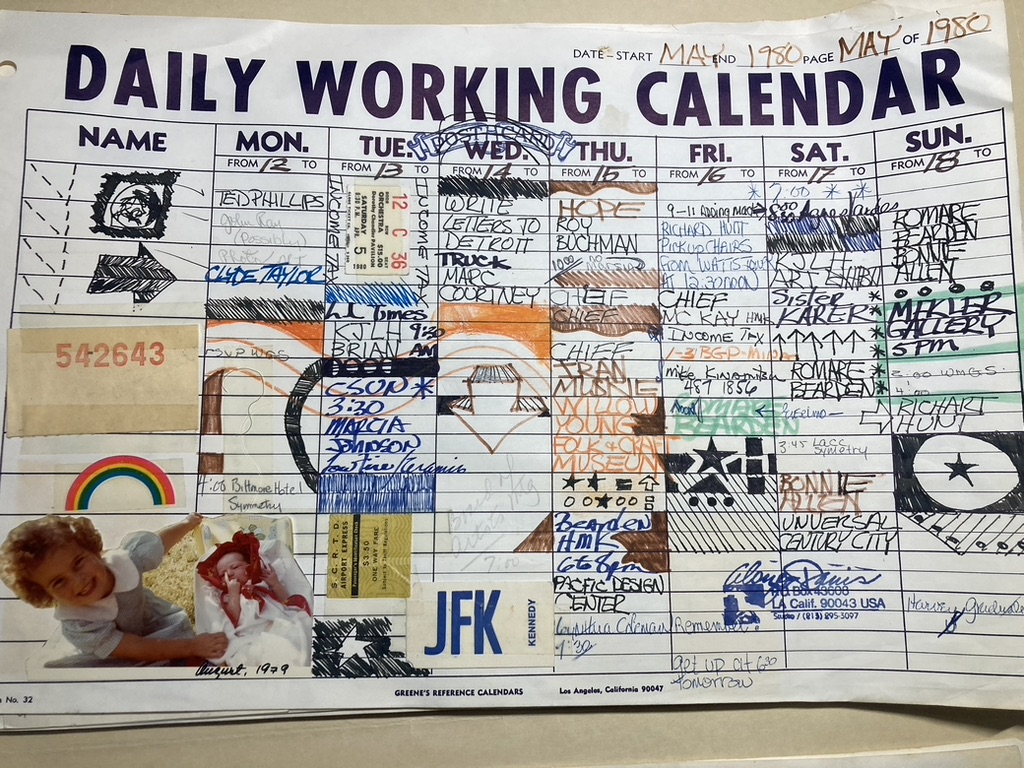
From a sensory perspective, there is absolutely no comparison between accessing digitized records or physical replicas and touching the real thing. Handling the original documents brought their creators into the room with me. I could sense them close by. The documents felt sacred…and vulnerable; like I shouldn’t even be allowed to touch them with my bare (though washed) hands. I kept marveling at the science of archiving for its ability to help us preserve these files for decades.
Because the collection is housed in LA Public Library, rather than in a fortress like the Getty Research Institute–where there are a multitude of physical, geographic, and psychological barriers to gaining access to their collections–at LAPL, anyone from the public can visit the records; it just takes making a reservation. This was an intentional choice on the part of Dale Davis, who helped organize and describe the collection before LAPL processed it. Following in the spirit of the community arts work he and his brother stewarded, he wanted the collection to be accessible to as wide an audience as possible. This heightened the sense of vulnerability for me, but it also increased my sense of responsibility to take the utmost care for what I was holding.
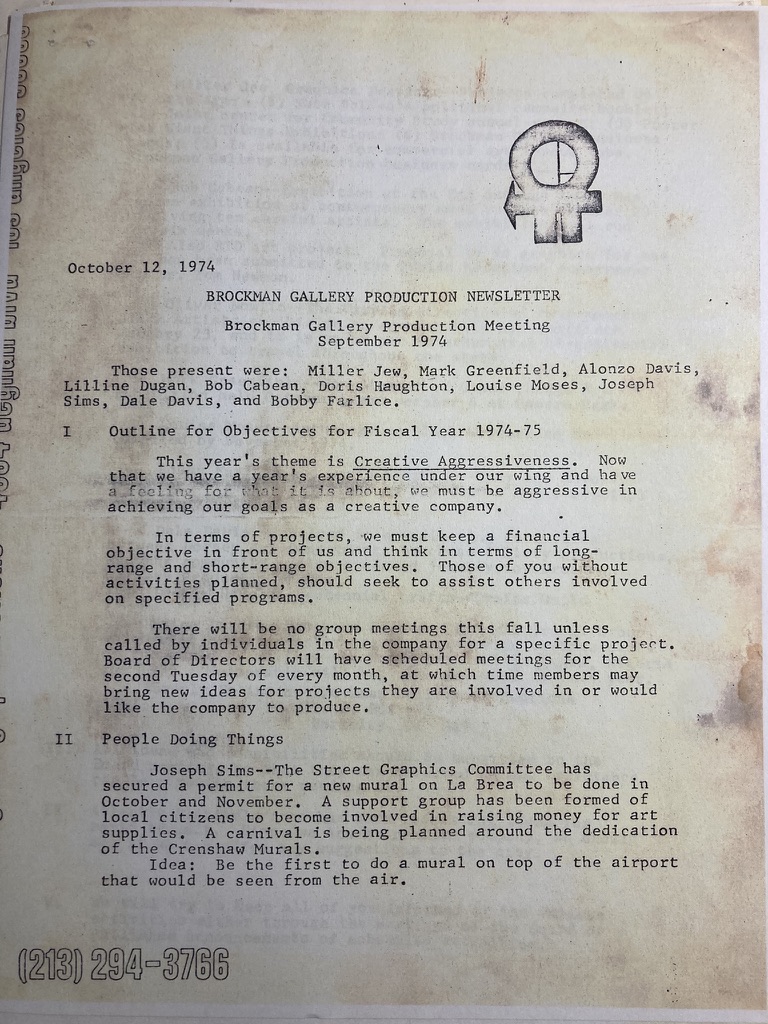
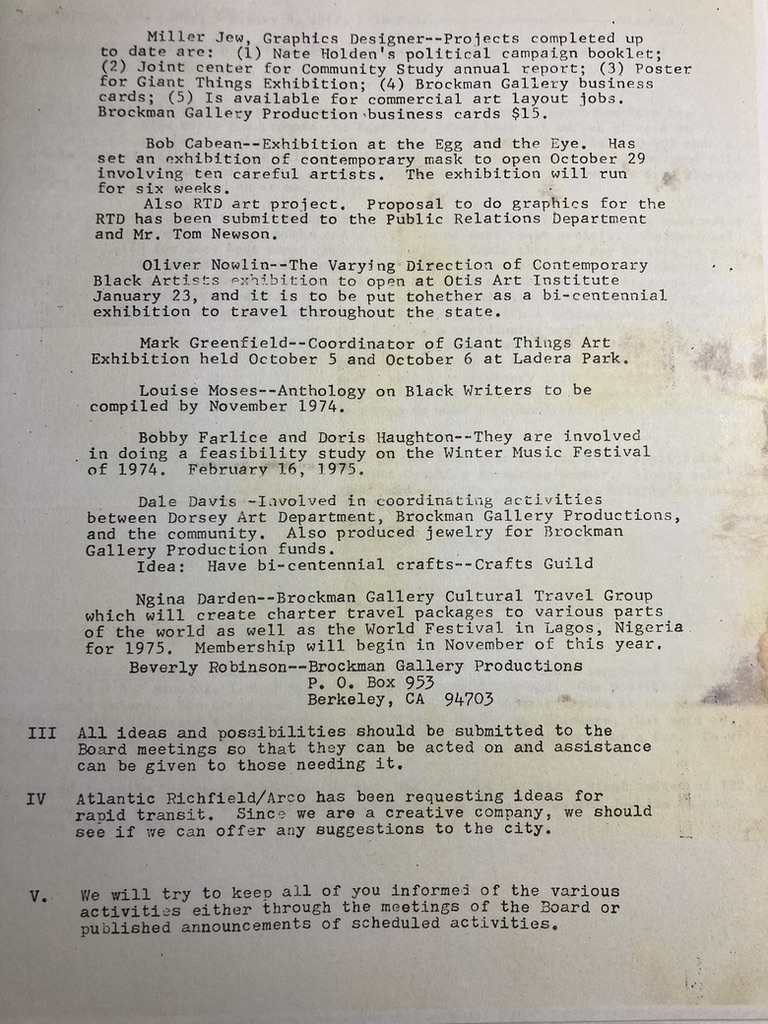
What also leapt off the pages was the absolute energy and excitement the BGP team had for what they were building. I read through meeting minutes from more than 10 years of Artists Board meetings (they did not use the term Board of Directors; the initial governing structure was a Board composed entirely of artists, and eventually a Board of Advisors was added to support additional partnerships and strategic thinking). The minutes contained sections like “People Doing Things” that listed all the different projects that affiliated artists were doing each period. There was a note in one that said, “All ideas and possibilities should be submitted to the Board meetings so that they can be acted on and assistance can be given to those needing it.” (It reminded me of a theatre exercise I used to do with teens, where actors offer devising ideas, and the group’s job is to respond, “Yes! Let’s DO it!”)
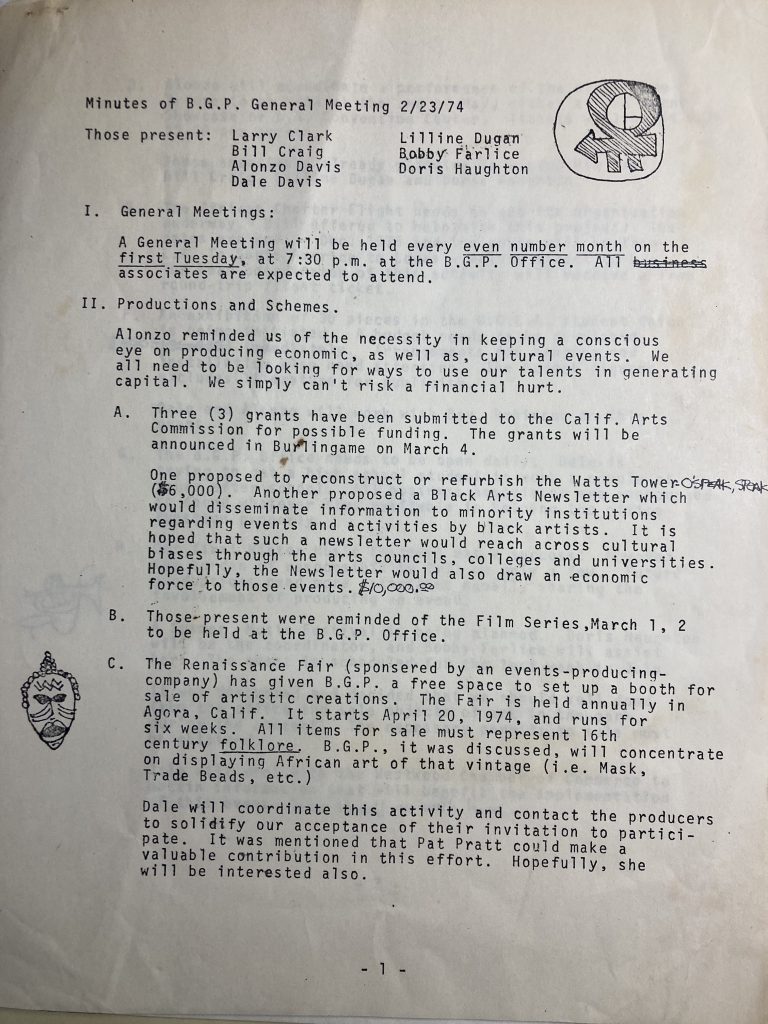
There was section of one meeting’s minutes titled “Productions and Schemes” that, before listing 16 completely different projects being simultaneously undertaken by the group, noted “Alonzo reminded us of the necessity in keeping a conscious eye on producing economic, as well as cultural events. We all need to be looking for ways to use our talents in generating capital. We simply can’t risk a financial hurt.” The orientation was first to create the thing that was needed, and then to try to resource the thing. In subsequent documents, there were letters between BGP staff and other organizations in the community proposing partnerships that would be mutually beneficial to each organization’s mission and budget. They were constantly seeking, growing, building, and manifesting creative “schemes,” (understood in its most positive, generative meaning) with the outcome of bringing more and more people into the fold to benefit from the collective work.
One of the biggest examples of this is the work done as part of a federal CETA [Comprehensive Employment and Training Act] award first awarded in 1977. Though the funding came with a lot administrative burden and stretched BGP’s capacity in a number of ways, over the span of multiple years, BGP was able to employ dozens of artists, apprentices, and administrators to produce cultural events and create public art for the community. The meeting notes are full of references to CETA, with all of its attendant boones and banes, but always with an eye towards how the money could be used to grow the creative economy and impact of the arts as a community-strengthening technology.
Scribbled on one side of what looks like a stationary sample, was a quote from [I believe] Dale Davis, that seemed part of a larger draft statement:
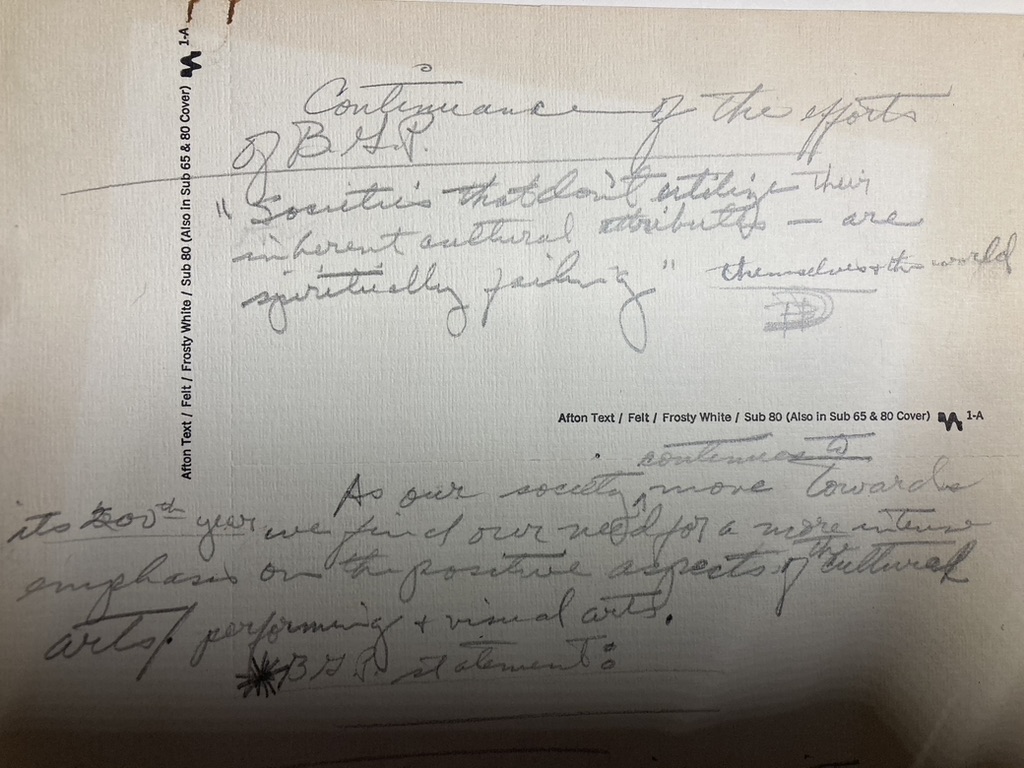
“Societies that don’t utilize their inherent cultural attributes—are spiritually failing” themselves and the world
The Davis brothers, and all of the artists, culture bearers, creative schemers, and “people doing things” through Brockman Gallery Productions certainly were utilizing every inherent cultural attribute available to them. I’m excited to continue digging in the archives and sharing reflections on this brilliance as my research grooves on…
[Side note: I learned that an exhibition—with a companion book by LAPL’s Angel City Press—about the impact of the Brockman Gallery will open at LACMA on Sunday, October 18 2026. The curators and researchers heavily drew on the items in the Brockman Gallery Collection. I look forward to seeing and learning from their interpretations and reflections on these records!]


Leave a Reply